

Are They More Likely To Repair My Car Instead Of Total Loss If I Have New Car Replacement
Introduction
When I first sat downward to write about the "repair or replace" dilemma, in the back of my mind there was a vague notion that a elementary, adding-based method would be the ultimate solution. I had heard of the 50% Rule and thought that information technology (or something like it) would be the obvious centerpiece of the decision-making process.
Nevertheless, my thinking on the topic rapidly evolved. As I reviewed my ain history of grappling with "repair or supersede," especially in the context of my role equally a CTO, I found it wrapped upwardly in all the glorious complexity of the bug faced by the entrepreneur. The need a machine fulfills is the driving force behind the controlling procedure. The myriad ways in which nosotros utilize machines to satisfy our desires, forth with the constraints and benefits presented past a particular state of affairs, are difficult to express in an equation.
Both repair and replacement have a long list of pros and cons associated with them. Depending on the circumstances, the decision-making factor that ultimately drives your decision can vary widely. Can a formula take into business relationship all of this complexity, and spit out the correct answer? My beginning laissez passer left the 50% Dominion wanting as a tool: information technology had no obvious way of incorporating the aspects which I felt were master considerations, so I completely cut any mention of it from my original slice, "Repair Or Replace?".
Withal, I was determined to revisit the issue and exam the fifty% Rule as a decision-making guide. That's because I establish so many references to it in various advice columns pitched to everyday consumers. Fifty-fifty the vaunted Consumer Reports mag cites it as a rule of thumb to resolve the repair or replace conundrum. Mayhap the 50% Dominion couldn't depict the complicated conclusion matrix used to choose a auto for a item purpose, simply maybe it did have a narrower context in which it should exist called upon? I wanted to find out.
It'southward Still Worth Something, Right?
Before we become to the 50% Dominion, I desire to discuss some basic ways to think well-nigh the economic value of repair. Let'due south start at the starting time, with the broken system itself: it'south like shooting fish in a barrel to forget that, although a machine is broken, it unremarkably retainssome worth. If y'all cull to forgo repair, you can often receive something in exchange for a non-working system. That something is called the salvage value. In bookkeeping, the term has a specific meaning with respect to depreciation: "the estimated value that an asset will realize upon its sale at the end of its useful life." Of course, whether or not to extend the "useful life" of a auto is exactly the decision nosotros're trying to brand.
Relieve values will vary widely depending upon the type of automobile and the market for its components. Many times a motorcar, even in a country of total disrepair, can be sold for parts to a local junkyard. Consumer electronics often fare much worse. For instance, considering a new one can be had for about nada, a broken DVD player will probable have no residual worth to others. In that location's 1 more than twist: sometimes a machine'south save value can be negative if there is a disposal cost involved. While I have sold cars to the junkyard in the past, I haven't always been successful in this endeavor. I remember when my first mini-van (don't laugh, information technology was a pretty sweet ride), which I drove out W when I first moved to San Francisco, was involved in an accident and completely wrecked. I called several local junkyards and was surprised that nobody wanted it—even when I offered information technology to them for free! I contacted some local tow-truck drivers, who had personal relationships with many more firms than I tried initially, and even they couldn't requite it abroad. That mini-van catastrophe up having a negative salve value of several hundred dollars, which included a disposal fee and the cost of a tow.
Scarcity and need drives the salvage value: yous tin can easily see this in the price paid for vintage cars and their parts. For case, there were merely a couple m Plymouth Superbirds built. Working or not, these cars are highly sought after by collectors and restorers, commanding a much higher cost than like vehicles from the same era. Finally, on the extreme finish of salvage values, I present this fine specimen to you lot: in 2022, Tata Motors unveiled an insane version of their Nano, slathered in most $4 million worth of precious stones and gold (80 kg, 22 karat!). The grandiose bling-o-rama of this publicity stunt has a curious effect on the relieve value of such a machine:
- Working gold-and-jewel-encrusted Tata Nano: $four million
- Non working golden-and-gem-encrusted Tata Nano: $4 1000000
Functional or not, this motorcar is worth virtually the aforementioned. This is one of those rare examples where a machine's value is independent of its working state.
Value-Added Repair
Whereas a breakdown takes away from a machine's value, repair should add together it back. However, recapturing that added value when it comes fourth dimension to sell is constrained by the other options available to buyers in the market. Y'all may be objectively improving a machine's capabilities by having it stock-still, but that investment won't necessarily be recognized by buyers and returned to yous afterward. Permit's walk through a archetype example of an uneconomic repair scenario. You buy a used car at the righteous price of $500. It may not await like much, but hey, information technology's transportation:
Afterward driving it for a few months, information technology breaks down. Afterwards consulting with a mechanic, it is determined that the transmission is bad and needs to be replaced. The full neb (parts and labor) for a new transmission is $2,000. You agree to the repair, thinking "If I spend $2,000 fixing the machine, it should be worth at least that amount subsequently, right?" A year later, yous want to upgrade your wheels and put the car upwards for sale, but are unable to observe a buyer in the $two,000 range. In fact, the all-time offering y'all become is $500, what yous originally paid for the motorcar in the first place. What happened to your significant repair investment?
Well, when you bought the car, you had many options of what to practice with your $500. As well, your potential buyers practice also. Automobile shoppers won't care what you lot've spent on the car in the by: they're only concerned with what their money can buy them now. If the prevailing market place cost for a similar used car is $500, then that is where y'all'll demand to price yours if y'all want it to sell. Sadly, all your $2,000 investment did was to restore the car to the point where it could be considered an equal amongst the other options in the $500 range. Certain, it has a brand new transmission, making it an undeniably amend car in that respect, only wait at the options from the perspective of a heir-apparent. They could take your asking price of $two,000 and buy four (iv 10 $500 = $2,000) equally bedraggled chariots, driving each one in turn until it dies.
The lesson here is that the market place will limit your ability to recapture the cost of repairs when it's time to sell. We can describe this state of affairs mathematically and endeavour to discover in advance if we're nearly to create a loss. I'll evidence you the formula for the unsaid value of a repair, to run into how the market values it. Offset, let'due south ascertain a couple of variables:
- gsalve = market value of the broken machine (aka, the salvage value)
- thoupost-repair = market value of the machine after repair
- rvalue-added = value added to the machine by the repair
which are related like this:
1000postal service-repair – msalvage = rvalue-added
For our manual instance, allow's say the salve value of our auto was $100. Sadly, we found out that the resale value of the car, fifty-fifty after making our costly repair, was just $500. Therefore the implied value of the manual repair was:
$500 – $100 = $400
This fix raised the value of the car from its salvage value of $100 to $500, so we tin say that the market value of the repair was the divergence: four hundred dollars ($400). I know what you're thinking: unfortunately, nosotros paid $ii,000 for this piece of work!
Let'southward prevent this from happening over again. Nosotros'll define one more than variable:
rcost = the direct, out-of-pocket toll of the repair
and note the relationship for an economically sound repair decision:
rcost ≤ rvalue-added
This inequality says that the improvement in the market value of a machine should be less than or equal to the cost of the repair. In our case, that wasnot truthful. Nosotros paid $2,000 which resulted in an increased value of only $400. Instead, we might have had more fun losing it at a casino, or created an art movie of ourselves burning the money. At least that would accept fabricated for a good cocktail party story.
Therefore, we tin can calculate a profit or loss from a repair as follows:
rvalue-added – rprice = rprofit/loss
In the case of our $2,000 transmission repair, that would exist a loss of:
$400 – $2,000 = -$1,600
Ouch. Notwithstanding, if you stay on the sunny side of this equation, there's also the chance to make gains from your repairs. Permit's say you take an amazing pair of mechanics at your disposal, like the deeply expert Tappet Brothers (perhaps the near famous troubleshooters of our time). They take your hunk of junk, brand a few clever jokes (at each other's expense), and set the transmission for $50. This allows you to sell information technology for $500 to some other sucker. Now, the turn a profit/loss calculation (r(value-added) – r(toll) = r(profit/loss) ) is a very happy one:
$400 – $50 = $350
A $fifty repair that improves the market value by $400 is a slam douse.
Where Did The Dough Become?
The chance of non recapturing your investment is present in and then many different situations in life and business organization. Dwelling renovations instantly come up to mind: you can do the aforementioned analysis of a dwelling's toll before and later a remodel. It's very easy to spend money on renovations that do not increment the value of a home by an equal corporeality, just like in the transmission repair example to a higher place.
But…where did the money go? How can it just disappear? This brings us to a very interesting aspect of making improvements to your possessions. Whether it's repairing a car, business firm, fridge, or reckoner, if you intend to resell information technology, you have become a de facto entrepreneur. No longer is the decision well-nigh the subjective value you receive from a successful repair, but rather about anticipating the future needs of buyers and the market conditions when it comes time to sell.
Fixing a cleaved machine with the intent of eventually reselling it is conceptually no different from what any manufacturer does. A pencil-maker assembles things similar brass, cedar, factice, mucilage, graphite, lacquer, pumice, and wax. Combining and transforming these raw materials with labor, he tries to correctly anticipate the public'southward demand for writing instruments, hoping to sell the pencils for a gain. (Please read "I, Pencil" for an eloquent and eye-opening narrative of the coordination and complexity required to produce this consumer staple y'all've probably taken for granted.)
In the example of the transmission repair, even though our product was a ane-off, nosotros temporarily became a manufacturer. We took some intermediate goods (a broken downwards car and replacements parts), hired some labor (the efforts of a mechanic), and created a new product: a lousy motorcar with a brand-new manual. Notwithstanding, is this something that potential buyers want and are willing to pay for at the toll we will offer later? I retrieve it's safe to say that the people who desire run-down cars desire them precisely considering they don't have brand-new transmissions. That is, they're trying to save money!
Nosotros could drive that car some other 500,000 miles until the transmission died again, making the repair solely for our own consumption. In that case, any marketplace-based loss would only exist theoretical. Whatever the outcome, devoting resource to the fix could be justified exclusively on our own hierarchy of values. Again, the market price is different from how much a repair is personally worth to you.
Of form, we'd still need to contend with opportunity costs, that nagging suspicion that our money could have been ameliorate spent elsewhere. The $2,000 we dropped on the manual repair could hands accept been allocated differently. Our beater could have been sold for its salvage value of $100. That amount plus $400 from our savings could have been spent on some other fabulous jalopy. Our transportation problem solved, the remaining $1,600 could then have been used on…a fabulous vacation to Hawaii! No thing how we forked out that $ii,000, we e'er run the risk of deciding, in retrospect, that it could have been better spent.
50%…Of What?
At present that nosotros've laid out the nuts for how to call back near the value of cleaved machines and repairs, let's move on to the 50% Dominion. Offset off, we should define the maxim. The bones idea is that you compare the price of repair to the cost of replacement. If repair exceeds fifty% of a particular threshold, the rule says y'all should opt to replace. But, if a repair can be completed for less than 50% of the baseline, then you should choose to set. So, the inequality favoring repair looks like this:
Repair Cost < Replacement Threshold × l%
Unfortunately, I couldn't find an official definition of the 50% Rule, at to the lowest degree with respect to the repair or replacement of machines (it seems more than well-defined in the world of real estate, insurance, and disaster recovery). What's specially problematic is that the threshold value that repair is weighed confronting is variously cited as:
- The original purchase toll of the broken machine.
- The current replacement value of an equivalent machine (i.eastward., a similarly used i).
- The toll of a new machine.
For a given state of affairs, each of these benchmarks could provide a wildly different respond, tipping the scales in either the direction of repair or replace. Figuring out what the standard should exist is going to be our outset challenge, and we haven't even gotten to the math and statistics behind the rule.
(epitome: US Regular army Photo)
The (Original) Toll Is…Wrong
Using the original purchase price as a standard for the fifty% Dominion would seem to exist the most problematic of all our choices. If a machine is old, aggrandizement volition have eaten away at the value of the price you paid for it, making it announced smaller. Using this equally a criterion will sadly tell you more about the misguided policies of central banks and the debasement of your money over time (leading to a wholly dissimilar "repair or supersede" word). While I encourage that introspection, it doesn't advance our goal of figuring out what to do with a broken machine. Too, it seems similar a lot to ask the boilerplate consumer to become out a table of inflation statistics and calculate constant dollars, tied to some benchmark year, like economists do. Although, the folks at the United states of america Bureau of Labor Statistics accept made information technology awfully easy to do just that, with this handy web-based aggrandizement figurer.
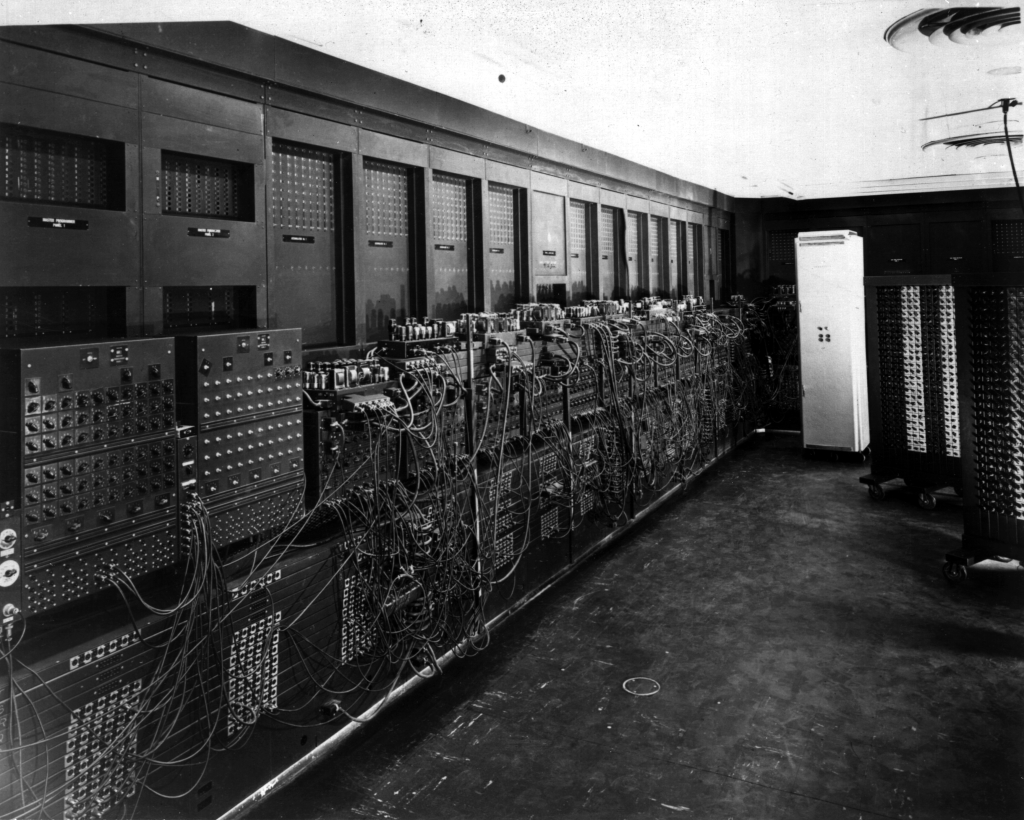
Counterbalancing the effect of aggrandizement on the original price is technological change, which will make the original price paid seem much larger. For example, the kickoff all-purpose digital computer was named ENIAC and built at the Academy of Pennsylvania in 1946. This "giant brain" was built at a cost of $500,000 (about $6 meg today). Using that sum to counterbalance a repair decision, with the thought that you lot would pay to accept another ENIAC built (even simply a few years later on), is folly. When it comes to industries where rapid innovation is taking place, current designs are often improve in all respects and cheaper too. This is definitely the case for most consumer electronics, particularly those bailiwick to Moore's Police.
Go Me Another One Like This (That Works!)
The replacement price of an identical car (i.e., a used one in similar condition) would seem similar a better choice as a basis for comparison, given that information technology keeps the variables in play at a minimum. This standard attempts to brand an apples-to-apples comparison past asking "How much would it price to learn a auto exactly like this?" Of grade, you want a automobile but like the broken 1, with one important difference: the replacement should work! Since the replacement cost is the price every bit ofnow, this standard won't endure from fourth dimension-based distortions similar inflation or technological change.
However, we should be articulate about the applied problems with this as a standard to exist employed in real-world situations:
- Finding an bachelor identical replacement is often impossible. You may exist contemplating a repair or replace decision for a 2022 Porsche Carrera with 10,000 miles, but what if the closest y'all tin observe in your area is a 2022 model with 25,000 miles? To use replacement toll equally a criterion implies that a replacement can actually be purchased! Yous may be able to look up the theoretical value in a price guide or come across recent auction closing prices, but that doesn't mean that one will be readily available to actually buy.
- Even if you can find an identical machine, it will not have been used the same way. Imagine two cars, rolling off the assembly line one after the other at a car manufactory. These twin specimens may be the same make, model yr, and take the same installed options. However, one machine is delivered to a suburban family unit and the other to the armada of a taxi company. After x years of utilize, these "identical" machines will be quite dissimilar: their wear patterns will reflect their much different working lives.
- For relatively rare machines, there may not exist a thriving secondary market from which to obtain pricing information. How much would it cost to buy a 1931 Royal Enfield Bullet? It might accept been years since i changed hands! Likewise, are the parties willing to disclose the cost paid? How much is your time worth to obtain this information? Remember the concept of opportunity costs before embarking on a wild goose chase for something rare.

(prototype: United states Army Photo)
Y'all've Moved On
As time moves on, your needs will inevitably alter. This is the biggest problem with automatically assuming an old machine (in the guise of replacement toll) should be revived or searched for in the used marketplace. Machines amplify our purposeful intentions; whatever rule of thumb that doesn't accept this into account is missing the indicate nearly why nosotros employ them. Although general purpose, the ENIAC was designed to solve WWII-era problems: the calculation of arms firing tables. In dissimilarity, the increased ability of the later BRLESC-I (Ballistic Research Laboratories Electronic Scientific Computer, launched in 1962) was needed to solve Space Historic period and Cold State of war issues involving nuclear weapons, missiles, and satellites. The ENIAC could perform 5,000 operations per 2d, but the BRLESC-I could do 5 meg. Repairing or replacing an equivalent auto isn't an choice when your needs take inverse. It doesn't matter if we're talking about a supercomputer, toaster, motorcar, or backhoe.
Having a machine that was doing useful work for yous malfunction is a loss: the resources you must at present devote to its repair or replacement can't exist used elsewhere. While this is a drain, y'all should make the best of it. Since modify is being forced upon you, take the opportunity to fully reassess your needs vis-à-vis the machine in question. Often, you lot'll notice that things take changed and your purposes could be better served some other way. At these pivot points, I've often made the conclusion to upgrade or downgrade, finding a amend fit with either a more than or less capable automobile. (Delight see the section titled "The Need, Reassessed" in "Repair Or Replace?" for the total give-and-take of this point.)
I've too decided to do zero: that is, to neither repair or replace, opting instead to simply cut ties and sell a machine for its relieve value. Especially for those things nosotros employ for leisure (aka, "toys"), you lot may find that the "need" was weak and your life is improve off without them entirely. Perchance you lot impulsively bought a gunkhole that yous thought y'all'd employ every weekend. Just, the maintenance hassles and your busy life resulted in the craft only existence used twice a twelvemonth. Perhaps you'd like the garage space dorsum. Retrieve the onetime saying: "The two happiest days in a boat owner's life are the day he buys it and the day he sells information technology." The sentiment behind this adage applies to and then many things, not just boats!
Lately, I've gained a tremendous satisfaction from reducing the number of "things" in my life. Your stuff has an overhead which may carry an unwelcome cost of ownership, especially if your life is already full. In these cases, a malfunction may exist an invitation to simplify and regain the most precious resource of all: your time.
Why Would I Pay More For The Same Thing?
Even though replacement cost has some potential problems, at to the lowest degree nosotros've establish a basis for comparison that'due south internally consistent and up-to-date. Unfortunately, there's a huge problem with using replacement price to calculate the 50% Dominion: it doesn't make any sense! Here's an example that shows why: let's say yous buy a refrigerator and it stops working afterwards the warranty menstruum expires (drat). Yours is a common model that's sold millions of units, and then equivalently used replacements are easily had for $400. The estimate for repair is $240. The 50% Dominion is:
rprice ÷kreplacement < fifty%
In our example:
$400 ÷ $240 = 60%
If repair costs $240 and an equivalently used replacement is $400, repair is 60% of the replacement toll. In this case, the fifty% Rule says to replace. What?! Think well-nigh what this means; we are supposedly comparing apples-to-apples. If you could pay $240 or $400 for the exact same thing, which would you choose? That's right, the cheaper 1! When comparison equivalent items, as long as repair is less than the replacement cost, you should repair (and vice versa). For this reason, there'southward no way we can use replacement cost equally the benchmark for the 50% Rule. Bizarrely, it recommends spending up to 100% more than—for the same thing!
New
Possibly instead we should be comparing the cost of repair to ownership a new machine. This has keen entreatment, given the issues often associated with finding a suitable and identically used replacement. Whether on-line, in a local shop, or via a phone phone call to a sales representative, manufacturers make it very easy to buy new. Information for new products is bachelor in abundance: commitment dates, specifications, and, well-nigh importantly, pricing details. Return policies are often generous compared to the "as is" nature of used sales. Warranties mitigate the risk of a ownership a "lemon" and give predictability to service costs (at least for a express time). There's much to be said for buying new.
Withal, once more we run into the fact that choosing new as the standard for comparison of the 50% Dominion requires a very of import judgement to be made first. Why incur the additional expense of buying new if a used machine will adequately run across your needs?
Yeah, here'south the rub: with new equally the standard, we're not comparison apples-to-apples anymore. A new machine will have different capabilities, warranties, maintenance costs, and longevity expectations. Presumably, nosotros'd like to assign a dollar value to these advantages and see if the additional expense was worth it. The simply thing the fifty% Rule would seem to say about the matter is that used is one-half as good as new. That's a pretty crude mode to evaluate your choices.
To see how utterly ridiculous things tin become when using new every bit the standard with the l% Rule, let'south return again to our broken down car that needs a $2,000 transmission. While there's nothing in the new market place that can hope to compare with our finely dented steed, if forced to cull an equivalent new replacement, we'll go with a lower-end 4-door sedan for $17,000. Permit's meet what the 50% Rule (rcost ÷thoureplacement < 50%) says to do:
$2,000 ÷ $17,000 = 12%
Because repair is less than one-half of the cost of a new 1, the rule says to repair. Sorry partner, them's the rules. Of course, y'all'd be an idiot to do that given that nosotros've shown the market value of such a repair would incur a huge loss. The follies don't end there: keep in heed that the rule would say that we should consider any repair upwards to $viii,500 (50% of $17,000). More than nonsense!
Game Over
I'thousand going to terminate here and declare the l% Rule to be a failure equally a practical controlling tool. The rule requires a criterion and, every bit I've shown, the ones offered all have serious defects. Using them could result in some very flawed outcomes.
If you want numbers to guide you, the value-added model of repair:
rvalue-added – rtoll = rprofit/loss
seems like a much ameliorate alternative. At a minimum, information technology should exist consulted to warn against expenditures that volition not be recoverable when reselling. I retrieve that's the biggest risk most consumers face and a frequently violated expectation. Because the market value of the machine after repair ( mmail service-repair ) is required to make this calculation, it forces you to consider an of import alternative for your coin: equivalent replacements available in the market. Finally, the value-added calculation is upward-to-date, forward-looking, and incorporates the current state of technological progress, while avoiding the effects of inflation and the temptation to consider sunk costs.
Merely beyond the numbers, you need to remain in touch with your needs and how a particular machine is serving them. Have those needs changed? What value does a contraption bring to your life or business organization? How does that compare to the alternatives available (like new models)? These considerations should come before any repair or replace calculations are made, otherwise yous volition be led by the garbage-in, garbage-out nature of blindly following the results of a formula.
What Do You lot Remember?
I'grand perplexed that the 50% Rule is cited every bit a rule-of-thumb for consumers. If y'all have a skillful defense that addresses the problems I've uncovered, or points out something disquisitional I've missed, I'm all ears. Tell me what you lot call up in the comments department!
References:
- Header image: Horydczak, Theodor, photographer.Automobiles. View from forepart of wrecked automobile. ca. 1920-ca. 1950. Photo. Retrieved from the Library of Congress, https://www.loc.gov/item/thc1995012467/PP/.

Are They More Likely To Repair My Car Instead Of Total Loss If I Have New Car Replacement,
Source: https://artoftroubleshooting.com/2014/04/25/the-50-percent-rule-repair-or-replace-revisited/
Posted by: nugentfolefornim.blogspot.com
0 Response to "Are They More Likely To Repair My Car Instead Of Total Loss If I Have New Car Replacement"
Post a Comment